
I
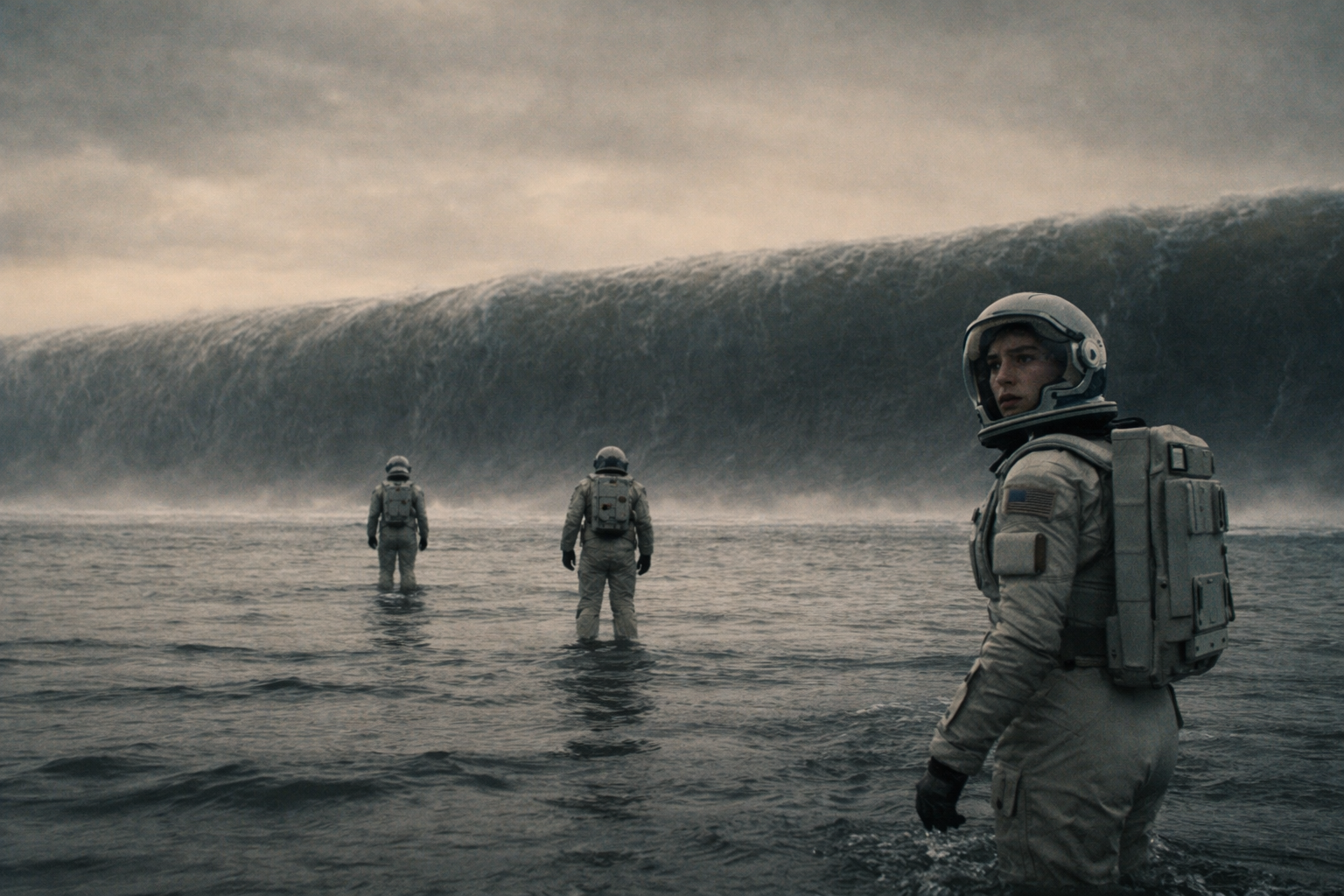
There’s a scene in Interstellar where the crew lands on a planet covered in ankle-deep water.
Mountains line the horizon.
The clock is ticking, and thanks to Einstein’s compression of time near the black hole, they have only minutes before they need to escape.
Then Cooper looks again. Those aren’t mountains. They’re waves.
“Imagine you’re cleaning a beach which has a few needles, trash, and is dirty. And there’s a 1,000-foot tsunami which is AI that’s about to hit. You’re not going to focus on cleaning the beach.” - Elon Musk, June 2025
II
In March 2020, my friend called and told me to get out of the United States before the ICUs overflowed and the planes stopped flying across the oceans.
I was in Massachusetts, nearing Spring break in the first year of my masters degree. My wife, then girlfriend, was mid-air over the Pacific, flying to visit me.
That night I went to El Jefe’s for tacos. Trump was on the TVs hanging from the ceiling, announcing he was closing the borders to Europe.

The planes had never stopped like this before.
But they did.
When my wife landed, she got an Uber out to Cambridge, and we immediately started packing.
Within 48 hours, we were on planes back to Australia. When my wife had taken off two days earlier, she overheard some fellow travellers making fun of her mask.
By the time we landed in Australia, our fellow travellers were sharing respirators with each other out of solidarity.
Australia closed her borders behind us and held the virus at bay for nearly two years, on this natural, continent-sized island quarantine.
I was studying exponential growth. I understood doubling times.
And yet I nearly got caught at the hinge.
This week, two of the smartest people in my life - who have never met each other - independently shared an idea with me:
“This is the February 2020 moment for AI.”
III
In The Second Machine Age, MIT professors Erik Brynjolfsson and Andrew McAfee retell the legend of the inventor of chess.
He presents his game to the emperor, who is delighted and tells him to name his reward.
The inventor asks for rice, merely to feed his family. One grain on the first square, two on the second, four on the third, doubling on each square of the 64-square chessboard.
The emperor agrees - a few grains of rice - he’s getting the chess set for a pittance.
And yet, halfway through the board - square 32 - the emperor owes him about four billion grains - a pile of rice, equivalent to a large field.
But here is what exponential growth actually means: four billion is not half of the final total. It is less than a billionth of it.
The total by square 64 is eighteen quintillion grains. More rice than has been produced in all of human history.
“Our brains are not well equipped to understand sustained exponential growth,” they write.

IV
METR is an independent organisation that evaluates AI capabilities - they have no product to sell, and no venture capital to impress.
They measure one thing: how long can an AI system work autonomously on a real software engineering task before it fails?
A system that lasts five minutes may be able to fix a simple bug you point it at. A system that lasts a day can write the entire software suite. And software is how AI builds the next, even more capable, generation of AI.
In March 2025, they found the software engineering task horizon was doubling every seven months.
By January 2026, they’d updated: the doubling time had shortened to just 4.3 months. Their most recent benchmark, Claude Opus 4.5, could work autonomously for about five hours. On February 5, its successor arrived - built, in large part, by the model it replaced.
If the 4.3-month doubling of January 2026 continues, without even speeding up, here is what the exponential curve implies:
By September 2026, the frontier approaches twenty hours - half a working week. By early 2027, a full week. By the end of next year, a month. These are not predictions. They are extrapolations of a measured trend. The trend could break. But in recent years, all it’s done is accelerate.
Each doubling means the system can take on tasks that are qualitatively different from the last - not just longer, but more complex, more integrated, more like the real-world tasks a software engineering employee does, unsupervised.
SWE-bench, a benchmark that uses real-world software engineering tasks, saw AI solve rates go from 4.4% in 2023 to 71.7% in 2024. These benchmarks have limitations - models may be trained on similar tasks, and benchmark design evolves - but a move that large in twelve months is impossible to explain away as measurement artifact.
These are all proxies for the hinge. The bend in the hockey stick. The arc of progress is bending upwards, and it has not yet shown signs of levelling off.
V
There are two observations the sceptic’s model has to explain away to earn its credibility.
First, the recursive loop. On February 5, OpenAI announced that GPT-5.3-Codex was “our first model that was instrumental in creating itself” - it was used to debug its own training and manage its own deployment. No previous technology has participated in building its successor at this speed and this level of generality.
Second, convergence. This is not a single technology on a single curve.
Hardware, algorithms, training data, and engineering tooling are all simultaneously improving, and compounding.
VI
In 2015 - five years before COVID-19 shut down the world - Bill Gates, the man who built Microsoft, stood on the TED stage and warned:
“If anything kills over 10 million people in the next few decades, it’s most likely to be a highly infectious virus rather than a war. Not missiles, but microbes.”
Tens of millions of people watched that talk. Nothing changed.
In January 2026, Dario Amodei, the CEO of Anthropic, warned: “Humanity is about to be handed almost unimaginable power, and it is deeply unclear whether our social, political, and technological systems possess the maturity to wield it.”
The insiders might be wrong. But right now, they’re all pointing at the horizon.
VII
Today, the world around us is changing at a speed that makes February 2020 look gentle. That virus doubled for two years and then stopped. AI has been doubling for decades, and the doubling time itself is shrinking.
My brother called me this week. My friend called me the same week.
They said the same thing, independently, in different words.
Can you feel it?
I can feel it. And this time, there’s nowhere to fly to.
Dr Alistair Quinn is a psychiatrist-in-training who holds a master’s in computational biology from Harvard. He builds AI tools for clinical psychiatry and writes at wecanlookup.org. He has a professional interest in AI being transformative - weigh that accordingly.